
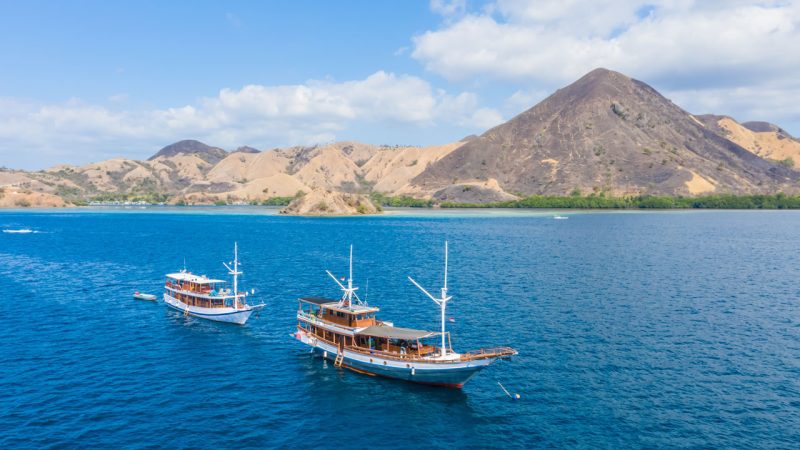
Most people arrive at this decision with a fixed number of days in Indonesia and a question about how many to give Komodo. The two answers on offer are a day trip out of Labuan Bajo, or an overnight liveaboard.
The comparison is usually framed as seeing more against seeing less, and that framing is misleading. For the sights most travellers come for, a day trip can cover much of the same ground as a multi-day trip.
KomodoYacht.com sells nothing, takes no commission, and has no relationship with any operator, so what follows compares the two formats rather than recommending one. For the wider picture on how boat travel in the park works, see our Boat Trips section.
What a day trip involves
A day trip leaves Labuan Bajo in the early morning, visits a set of sites inside the park, and returns the same evening. Operators commonly describe these as running ten to twelve hours, though the length depends on the boat and the itinerary sold. The day is scheduled tightly, because everything has to fit between departure and return, and you sleep on land either side.
What a liveaboard involves
A liveaboard is a boat trip with nights aboard. You sleep in a cabin, meals are provided, and the boat moves between sites while you are on it.
Trip lengths vary: operators sell one night, two nights, and longer arrangements, with dive-focused trips sometimes running further again. What is included, and how the days are structured, differs by operator.
The reach question: do you actually see less on a day trip?
For the headline sights, a day trip can cover many of the same places as a liveaboard. Operator descriptions of one-day itineraries and of two- and three-day trips overlap substantially on the sites travellers come for: a viewpoint hike, a dragon trek, a pink-sand beach, and a snorkelling stop or two.
That is not the same as saying the itineraries are identical. The number of stops differs, the time at each differs, the order differs, and every operator sells something slightly different. Some liveaboard routes do include sites a one-day trip is unlikely to reach. But the common assumption — that a day trip means missing the famous places — does not hold up against what operators advertise on both sides.
What a liveaboard primarily buys is time, timing and pace, not a completely different list of destinations. Whether that is worth the extra days is a real question, just a different one from what most people think they are asking.
What genuinely differs
Hours in the day
A day trip has one working day, and travel to and from Labuan Bajo comes out of it. A liveaboard spreads the same sites across more hours and moves between some of them while you sleep. The practical result is not more places but longer at them, and less of the day spent watching the clock.
Pace at each stop
Operators describing day trips consistently characterise them as efficient by necessity: each stop has a window, set by what must happen before dark.
On a longer trip, the pace is looser. Whether that matters depends on how you travel. Some people would rather see the same things briskly and gain a day elsewhere in Indonesia; others find a compressed schedule takes the pleasure out of it.
Crowds and timing
Liveaboard operators report being able to reach sites outside the main day-boat window, arriving before or after the concentration of one-day trips. That is operator-reported rather than independently established, and depends on the individual boat’s route, so no liveaboard guarantees it. Day trips arrive within a narrower band of hours.
Light and photography
This is the most concrete difference, and the one photographers care about. Early-morning and late-afternoon light largely falls outside a day trip’s window, since the boat is travelling at both ends of the day. A liveaboard makes early positioning more practical, because the boat can already be near a site at first light.
Practical, not guaranteed. Whether a particular trip is at a particular place at a particular hour depends on the operator’s route and on park arrangements, which apply to everyone. If early light is the reason you are considering a liveaboard, ask the operator directly what their schedule allows rather than assuming it.
Comfort and sleeping arrangements
This one is genuinely two-sided, and the assumption usually runs one way.
A liveaboard means sleeping aboard a boat: a cabin at sea, with the movement, sounds and confined space that involves. Some travellers find it the best part of the trip; others sleep badly, and a bad night affects the following day. A day trip means an early start and a long day, followed by your own bed in Labuan Bajo.
Neither is more comfortable in the abstract. They are different things, and cabin arrangements vary considerably between boats.
How the cost structure works
No prices appear here, because operator pricing varies too widely to be useful. The mechanism stays true: a day trip generally involves paying for one day of boat and crew, while a liveaboard generally involves a longer arrangement that may also cover accommodation and meals across several days.
What is included, and how each operator charges, differs. Comparing headline figures without checking what each covers will mislead you.
The variable inside “day trip”: which boat
“Day trip” is not one experience, and the boat you travel on changes the day materially. A faster boat spends less of the available hours moving between Labuan Bajo and the park and more of them at the places you came to see; a slower boat reverses that balance. Within a fixed number of daylight hours, that decides how much of the day is actually spent ashore or in the water, and two trips sold as the same one-day tour can deliver quite different days.
If you are choosing a day trip, ask what boat it uses and how long the journey takes before comparing anything else. Vessel classes are a subject in their own right; here the relevant question is simply how much of your day the travelling will take.
The middle option: two days, one night
Between a one-day trip and a longer liveaboard sits a two-day, one-night format that many travellers overlook. It adds a night aboard and a second morning in the park without committing several days. For someone who wants more than a compressed day but does not have three or four days to spare, it is often the format that fits.
Whether it is enough depends on what you want from the park, and what else your trip has to accommodate.
Park entry and the visitor quota
Park entry has to be arranged whichever format you choose. BTNK officials have reported a daily visitor limit of 1,000 people, reported to be in effect since 1 April 2026. How that limit interacts with different trip formats is not something we have been able to establish, and neither format should be assumed to have priority or better availability.
The practical advice is the same either way: confirm with your operator how park entry is handled, and whether it is included in what you are paying. Our guide to park fees and permits covers how entry and reservations work.
Which suits your trip
If you have one day
A day trip can cover many of the main sights, but the trade-off is a full, fast day with limited time at each stop. Prioritise the boat question above, since it decides how much of the day you actually spend in the park.
If you have two or three days
This is where the choice is genuinely open. A liveaboard uses the time for slower days and different hours; a day trip plus a day in Labuan Bajo uses it differently. The two-day, one-night format is worth pricing alongside both.
If photography matters most
The case for a liveaboard is strongest here, because light is the one thing a day trip structurally struggles to offer. Confirm the specific schedule with the operator rather than assuming early access comes with the format.
If you are diving
Dive trips follow a different planning logic, with their own trip lengths, site selection, and scheduling. If diving is the point of your trip, the comparison above is not the one you should be making.
Where operators differ
More varies between operators than between the two formats, which makes this worth checking before booking:
- What is included — meals, water, snorkelling equipment, guides, transfers
- Whether park entry is included or charged separately
- Trip length and what each day contains, particularly for two-night and longer trips
- Which boat is used, and how long the journey takes
- Cabin arrangements on overnight trips
- Departure and return timings, which are not standard
Because none of this is standardised, comparing two trips on price alone will mislead you.
The trade-offs each way
A day trip costs you time at each stop, access to early and late light, and a relaxed pace.
A day trip gives you the main sights in a single day, a bed on land, and the rest of your itinerary untouched.
A liveaboard costs you more days from your trip and requires you to sleep aboard, which does not suit everyone.
A liveaboard gives you longer at the same places, potentially different hours, and time on the water as part of the experience rather than as transit.
Neither format is better. They spend your time differently.
How to decide
- How many days can you actually give Komodo? This usually settles it before anything else does.
- Is a compressed day acceptable to you, or would it spoil the trip? Answer honestly.
- Do you sleep well on boats? If you do not know, that is worth weighing before committing to nights aboard.
- Does early light matter to you? If yes, that points toward a longer trip, with the schedule confirmed in advance.
- If you are taking a day trip, ask about the boat first. It affects your day more than most other choices.
- Compare what is included, not headline prices.
Sea conditions affect both formats, and more time on the water means more exposure to whatever the sea is doing. Our guide to the best time to visit covers how conditions vary through the year.
One thing worth separating out: this comparison is about how long your trip lasts. Whether you share the boat is a different decision, covered in our comparison of an open trip or private charter. The two choices combine, and either format can be shared or private.
Frequently asked questions
For the headline sights, yes. The trade-off is pace and timing rather than places missed, and the boat used makes a substantial difference to how the day feels.
Operators commonly sell day trips covering both, along with a beach and a snorkelling stop. What is included depends on the specific itinerary, so check what a given trip actually covers.
Not necessarily more places, at least among the well-known sights. What you get is more time at them and potentially different hours of the day. Some longer routes do include sites a one-day trip is unlikely to reach.
Not automatically. A liveaboard means sleeping aboard a boat, which suits some travellers and not others. A day trip means a long day followed by your own bed. Cabin arrangements vary considerably between boats.
Two days with one night aboard adds a second morning and a slower pace without committing several days. Whether that is enough is a personal judgment, and what is included varies by operator.
Leave a reply